


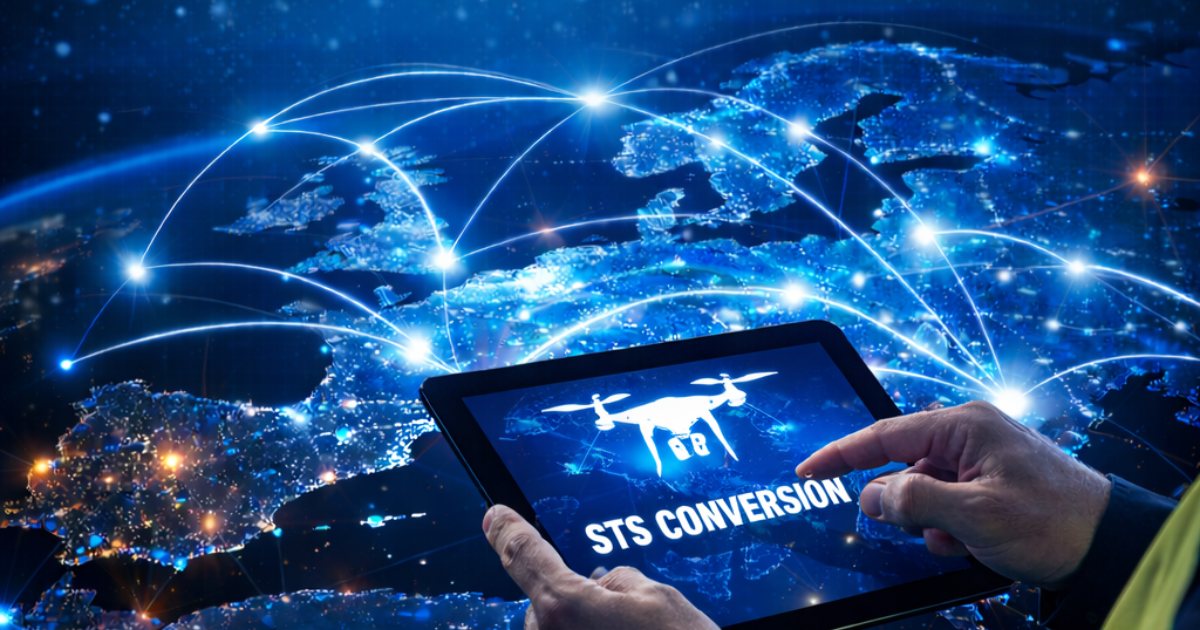
What is the European STS and why is it key now?
The European STS (Standard Scenario) allows operating in a specific category under standardized scenarios recognized throughout the European Union.
There are mainly:
STS-01
VLOS operations in a populated environment with class C5 drones.
STS-02
BVLOS operations in a sparsely populated environment with class C6 drones.
The important difference:
- The European STS is valid in all Member States.
- The national NO.
And here the mistakes start.
Mistake 1 — Thinking that “there's still time”
Many operators say:
- “I'll do it when it's mandatory. ” *
That thinking is dangerous.
Why?
- Administrations are already aligned with EASA regulations.
- Tenders are beginning to require European compliance.
- Large companies are already asking for it as a contractual requirement.
- In 2026, transitory national scenarios disappear.
Waiting doesn't save you effort. It only delays the inevitable and causes you to lose your competitive advantage.
Mistake 2 — Not understanding the business impact
Many see the STS as a technical procedure. It's not.
It's a market filter.
If you are not up to date and another operator is:
- You can work outside of Spain.
- You can access European contracts.
- It can operate with greater regulatory support.
- It transmits more professionalism.
In sectors such as:
- Technical agriculture
- Advanced topography
- Energy
- Security
- Services for administrations
Not being up to date starts to be a real disadvantage.

Mistake 3 — Believing that your old course is “worth it”
Many operators trained under national regulations years ago and have not been updated again.
The problem:
- They are not aware of the new documentary requirements.
- Changes in risk management do not dominate.
- They are not aligned with European standards.
- They don't understand the conversion requirements.
Not being technically up to date means becoming professionally obsolete.
Mistake 4 — Underestimating inspections and audits
The inspections are increasing.
And when they arrive, they ask for:
- Updated certificates
- STS operational statements
- Aligned operations manual
- Correct risk assessments
If you're not adapted, it's not just a fine. It is the possible stoppage of operations.
Mistake 5 — Thinking that “I only work in Spain”
Serious strategic error. The drone market is increasingly connected:
- International customers
- Cross-border projects
- Outsourcing
- European Consortiums
If you can't trade under the European standard, you're automatically left out of many opportunities. Even if it doesn't affect you today, tomorrow it can.
What should an operator do now?
If you haven't done the conversion yet:
1. Review your current situation
Do you operate under the old national scene? Does your certificate predate the European STS framework?
2. Analyze if you need STS-01, STS-02, or both
It depends on the type of operations you perform.
3. Plan the conversion before the market forces you
Waiting until the last minute usually means:
- Saturation of training centers
- Administrative errors
- Lost opportunities
Early bird traders always play with an advantage.
Conclusion
Not upgrading to the European STS is not simply leaving a process pending.
It has real consequences:
- You may lose opportunities to other operators.
- You can limit your access to certain contracts.
- You may take on more risk than necessary.
- And, without realizing it, you can project a less up-to-date picture of your activity.
The drone sector is no longer in its infancy. It's maturing. And when an industry matures, the requirements become more professional.
More and more customers are asking for regulations, for coverage, for documentation. Not out of curiosity, but because they too have responsibilities to cover.
Therefore, rather than wondering if it will be mandatory at all or when transient scenarios will permanently disappear, perhaps the most sensible question is another:
Am I ready for the next level of demand?
Upgrading to the European STS should not be done out of fear or urgency, but rather out of planning.
Reviewing your current situation, understanding what scenario you need really and adapting your operations in time is a strategic decision, not just an administrative one.
At Gridflight work precisely at that point: helping operators analyze their specific case and take the step in an orderly manner, without unnecessary complications and with a vision of the future.
Because complying is fine. But being well positioned in the market is better.


